Silk Fabric
Silk is a natural protein fibre, spun by silkworms into a continuous filament rather than the short, spun fibres that make up cotton or wool. That filament structure is unusual because the raw fibre has a triangular cross-section, and it is this shape, not any coating or finish, that bends light in a way no synthetic fibre fully replicates. It is what gives genuine silk its shifting, natural sheen rather than a flat, uniform shine.
The same continuous filament also gives silk real strength for how fine it feels. Despite its light, smooth handle, silk fibre has a high tensile strength, which is why it holds embroidery, beadwork and heavier embellishment without tearing or sagging over the course of a long event. It takes dye exceptionally well, producing the deep, saturated colours associated with bridal and festive pieces. The trade-off is that it needs gentle handling. Silk should be dry cleaned or hand washed and kept out of direct sunlight, since prolonged UV exposure will fade and weaken the fibre over time. Check our selection in the dedicated Silk Fabric Collection and get inspiration via Buy Long Pakistani Maxi Dresses: Party & Formal Wear.
Raw Silk Fabric
Raw silk is woven from silk filaments before the natural gum coating the fibre, called sericin, has been fully removed. Regular silk goes through a boiling and washing process that strips this gum away, leaving the smooth, glossy filament behind. Raw silk skips most of that stage, so the gum stays partly intact and binds slubs and small irregularities into the yarn as it is spun.
Those slubs are what give raw silk its texture, a slightly nubby, matte surface that looks and feels completely different from the smooth sheen of regular silk. It has a firmer, more textured drape as a result, which suits structured cuts and tailored panels rather than the fluid fall you get from finer silk. It still carries silk’s natural strength and takes dye and embroidery well, so it turns up often in formal and semi-bridal pieces where a raw, textural finish is preferred over high shine. Explore the raw silk fabric collection for current pieces.
Organza Fabric
Organza looks related to chiffon at a glance, since both are sheer, but the two are built in almost opposite ways. Chiffon gets its softness from a high-twist yarn woven loosely enough to flow. Organza uses a similarly fine, tightly twisted yarn, but it is woven in a much denser plain weave, packing far more threads into the same space. That density is what gives organza its stiffness instead of chiffon’s fluid fall.
Traditionally, the fibre was silk, though most organza used in Pakistani suit fabric today is polyester or a silk-synthetic blend, chosen because it holds its crispness through repeated wear and pressing. The result is a fabric that is sheer enough to let light through but firm enough to hold a shape on its own, standing away from the body rather than clinging to it. This is exactly why it is used for structured necklines, voluminous sleeves and formal panels, and why it is often layered over another fabric for extra body rather than worn on its own. See the organza fabric collection to compare designs and read our selection tips via Shop Luxury Pakistani Designer Formal Wear Online.
Embroidered Net Fabric
Net fabric is woven with an open, mesh-like structure, made by knotting or looping fine yarn so that the finished cloth is mostly space rather than solid thread. On its own, it has almost no opacity or structure, which is exactly why it is used as a base for heavy embellishment rather than worn plain. The open weave gives embroidery thread, sequins, and beadwork something to anchor to without the added weight of a solid backing fabric.
This is what makes embroidered net so distinctive in bridal and formal wear. Because the base fabric is sheer, the embroidery itself becomes the visible surface, giving the finished piece a floating, almost weightless look even when the embellishment is dense. It needs a lining underneath for a kameez, in the same way chiffon does, but the combination of a barely-there base and heavy handwork is something no solid weave can recreate. Explore elegant embroidered net fabric designs and match them to your events with our guest handbook: What to Wear to a Pakistani Wedding in the UK.
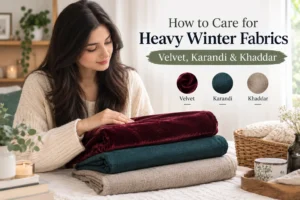
Velvet Fabric
Velvet is woven differently from every other fabric on this list. It uses two sets of warp threads instead of one, a base set that forms the backing cloth and a second set that is woven in loops, then cut. Cutting those loops is what creates velvet’s short, dense pile, the layer of upright fibre ends that gives the fabric its soft, brushed surface rather than a flat woven face.
That pile structure is also why velvet performs so well in cold weather. The upright fibres trap a layer of air against the base fabric, working in a similar way to khaddar’s dense weave but through a completely different construction. The pile also catches and scatters light differently depending on which direction you brush it, which is what gives velvet its characteristic depth of colour and the slightly shifting shade you see as it moves. It is genuinely warm enough to wear on its own through a UK winter, which is why it is used so often for winter weddings and evening events.
The one thing to watch is the pile itself, which crushes under pressure, so velvet pieces are best hung rather than folded and dry cleaned rather than pressed with a hot iron. You can review full profiles such as Types of Velvet for UK Weddings, learn about heavy drafts via Is Velvet Too Heavy for Indoor UK Weddings?, study design cuts in Types and Styles of Velvet Suit Designs, or check out the latest styles directly in our premium Velvet Fabric Collection.
Jacquard and Banarsi Silk
Jacquard is named after the loom that makes it possible, invented by Joseph Marie Jacquard in the early 1800s. Ordinary looms weave a flat, single pattern across the whole width of the cloth, but a jacquard loom can raise and lower every individual warp thread on its own, controlled originally by a chain of punched cards and now by computer. That control lets the loom weave a design directly into the structure of the cloth rather than printing it on top afterwards.
Because the pattern is woven rather than printed, it shows on both faces of the fabric and cannot crack, fade or peel the way a surface print can over time. The motifs usually sit slightly raised from the background weave, giving jacquard a subtle texture you can feel as well as see, and the fabric tends to be moderate to heavy in weight with a good deal of structure. Banarsi silk uses the same woven-pattern principle but on a silk base, traditionally with metallic zari thread worked through the motifs, which is why it remains one of the most prized fabrics for bridal wear. Take a look at the jacquard fabric collection for pieces with this woven finish.
How to Identify Authentic Pakistani Fabric
Authentic Pakistani fabric is easiest to spot by looking closely at the print, the embroidery and the labelling, rather than judging by price alone. For a wider industry outlook, see our comprehensive breakdown: Pakistani Clothing Brands in the UK: Ultimate Guide.
Print Quality and Colour Registration: On genuine fabric, the print edges are sharp and clean, with no colour bleeding where one shade meets another. On a poor copy, the edges blur, and fine detail lines look fuzzy under close inspection.
Embroidery Tension and Thread Weight: Well-made embroidery lies flat, has visible depth, and does not pull when you gently tug the thread. Lower quality embroidery is flatter, more uniform, and the backing fabric often shows through between stitches.
Sewn Brand Labels vs Printed Tags: A genuine designer fabric set carries a sewn-in fabric label with the brand name, collection name and an article code, not a printed sticker. Checking for this label is one of the fastest ways to confirm you are buying an original piece rather than a copy.
Every set in our Unstitched Pakistani Suits Collection is sourced as an original designer piece, so you can shop with that confirmed from the outset.
Choosing Pakistani Fabric for UK Weather
UK weather rarely matches the extremes Pakistani fabrics were originally designed for, so matching fabric to season matters more here than it might elsewhere.
Best Fabric for British Summer: Lawn and cotton are the strongest choices for a British summer. Both stay breathable through warm spells and still feel comfortable on the cooler, cloudier days that UK summers are known for. Our summer collection is built around exactly this brief.
Best Fabric for Transitional Autumn: Cambric and light khaddar work well through autumn, when mornings are cold but afternoons can still be mild. Both give you a bit more warmth than lawn without the full weight of a winter fabric.
Best Fabric for UK Winter: Khaddar, karandi and velvet are the fabrics to reach for once winter sets in properly. Each one traps warmth on its own, so you can wear the suit with just a coat over it rather than layering heavily underneath. Our winter collection groups these fabrics together for easier browsing.
Pakistani Fabric Care Guide
How you wash and store a Pakistani suit matters as much as which fabric you chose in the first place, since the wrong care routine can undo an otherwise good fabric quickly. The right approach depends on the weave and fibre, so it is worth treating summer, formal and winter pieces differently rather than washing everything the same way.
Washing and Drying by Fabric Type
Lawn, cotton and cambric: machine washable on a gentle cycle, dry flat to avoid stretching.
Chiffon, organza and silk: hand wash or dry clean only, never wring.
Khaddar and karandi: hand wash or a gentle wool cycle, reshape and dry flat.
Velvet: dry clean to protect the pile.
Ironing and Storage Tips
Iron lawn and cotton on a warm setting while still slightly damp. Chiffon and organza need a cool iron with a cloth barrier, or steaming instead of direct heat. Store embroidered and silk pieces folded in a breathable bag rather than on a hanger, to stop the embroidery from pulling out of shape.